


Every school has two lists of the same students. The admission office has one. Accounts has another. In principle they describe identical people. In practice they never quite agree, and reconciling them is somebody's recurring job.
The gap is rarely dramatic. A handful of students, a few concessions, some payments recorded in one place and not the other. But it surfaces at exactly the wrong moments, usually at audit, and it makes the school's own numbers something to be verified rather than trusted.
The records are created at different moments by different people
The mismatch begins at admission.
A student is admitted. The admission office creates a record with the child's details, the class, the date of joining. That record is complete and correct.
Some time later, sometimes the same day and sometimes a week afterwards, accounts creates a second record for the same child so that fees can be raised against it. The details are re-entered by a different person working from a form, a note or a verbal handover.
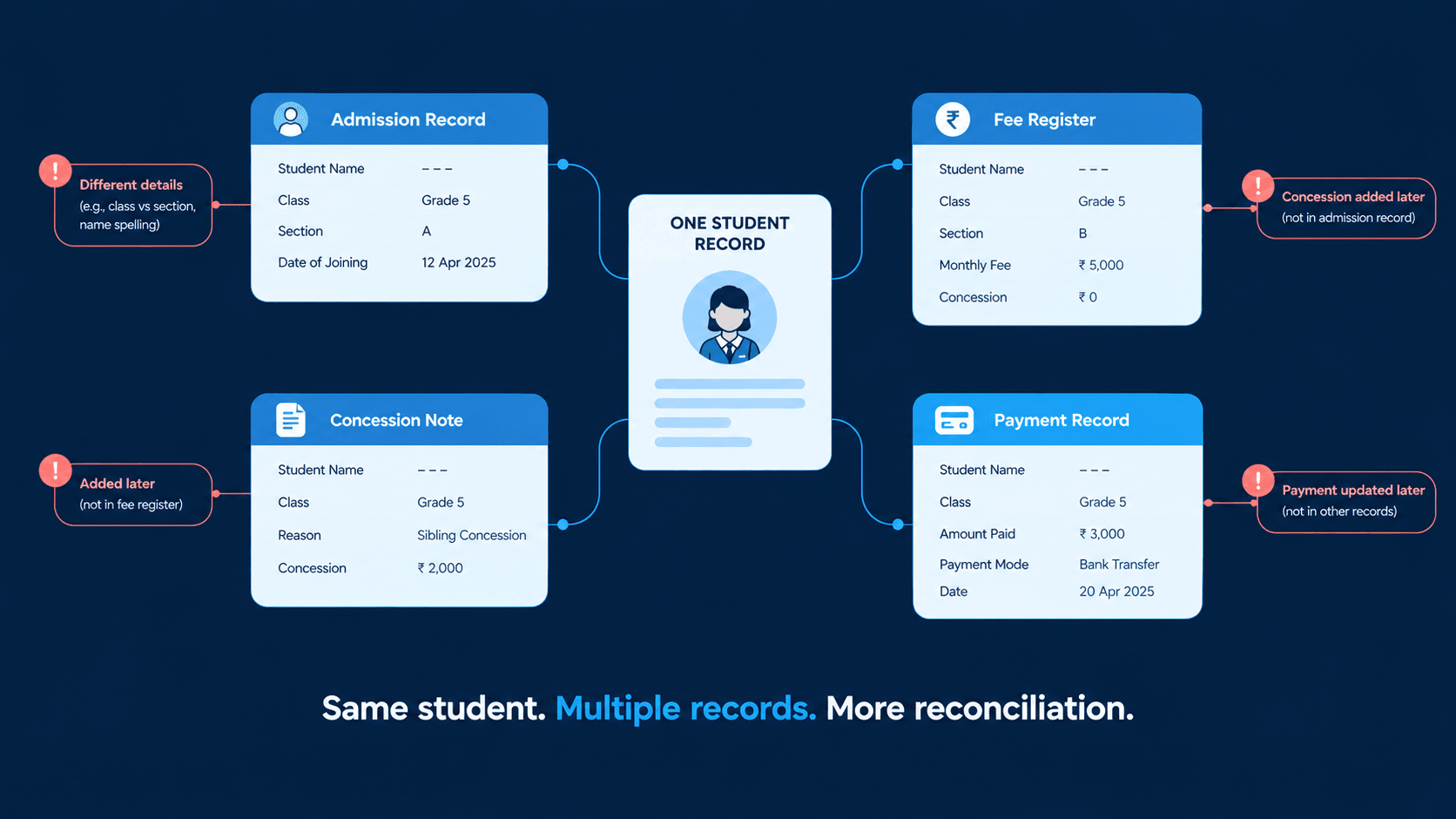
Most of the time the two records match. Occasionally a name is spelled differently, a class is recorded as the section rather than the grade, or a sibling's details get attached to the wrong child. These are not careless errors. They are the ordinary consequence of one fact being written down twice by two people.
Concessions are where the two records diverge permanently
The larger source of mismatch is concessions, and it is worth understanding why.
A fee concession is usually approved verbally or on a note, often by the correspondent or the principal, frequently outside the admission process and sometimes months after the student joined. Staff children, siblings, hardship cases, merit scholarships, a family known to the management.
That decision changes what the student owes. It is recorded in accounts, because accounts needs it to raise the correct bill. It is often not recorded on the admission record, because the admission record was completed long before.
From that point the two records describe the same child differently, and neither is wrong. The admission list holds the standard fee. The fee register holds the actual fee. Anyone comparing the two finds a discrepancy and has to investigate whether it is an error or an approved decision.
Payments made outside the system
The third divergence is payment.
A parent pays in cash at the counter. A receipt is issued from a book. The entry is made in the fee register at the end of the day, or the next morning, or on Monday. If the person who took the payment is not the person who maintains the register, there is a handover in between.
Another parent transfers the money directly to the school's bank account and sends a screenshot on WhatsApp. That payment exists in the bank statement but may not reach the fee register for several days.
A third pays at a branch office of a multi-campus school, and that entry travels to the main office on a consolidated sheet at month end.
Each of these is a normal way for money to arrive. Each of them means the fee register is accurate as of the last time somebody updated it, rather than as of now.
What the gap actually costs
The cost is not usually lost money. It is delay and effort.
Preparing the outstanding fee list takes a day or two, because it has to be assembled and checked rather than opened. By the time it reaches the principal, some of those parents have already paid. Reminders go out after the due date rather than before, and to people who no longer need them.
At audit, the reconciliation takes longer than it should and produces questions that require someone's memory to answer. Approved concessions with no written trail are particularly difficult to explain.
And a simple parent question, what does my child still owe, becomes a manual check rather than a lookup.
The underlying condition
None of this is a record-keeping failure by the staff. Both records are maintained carefully. The problem is that there are two of them.
Any fact held in two places requires somebody to keep them in agreement, and that work grows with every student. It is invisible in a school of two hundred and it is a permanent job in a school of a thousand.
The alternative is not better reconciliation. It is one record that admission and accounts both write to, so the fee position is a view of the student rather than a separate copy of them.



Discussions(0)
Join the technical exchange. Professional perspectives and insights welcome.
No thoughts shared yet
Be the first to join the conversation and share your insights on this topic.