


There is a week each term when a school stops functioning normally. Teachers stay late. The office turns down other requests. The principal fields questions about when results will be ready.
The work itself is not complicated. Marks are added, averaged, ranked and printed. What makes it consume a week is that the data has to be moved by hand between several places before any of that can happen.
Marks are entered more than once
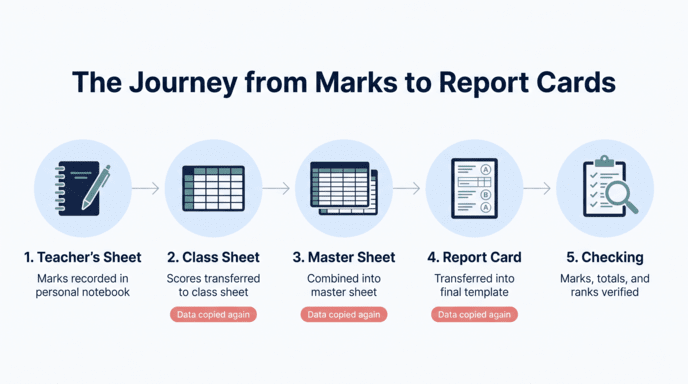
Follow a single mark through a typical school and the problem becomes obvious.
A teacher marks a paper and writes the score in their own record, usually a notebook or a personal sheet. At the end of the assessment, they transfer those scores into a class sheet, often a printed format supplied by the office.
Those class sheets are collected and consolidated into a master sheet covering all subjects for each student. That consolidation is done by hand or in a spreadsheet by someone in the office, working from the sheets the teachers submitted.
From the master sheet, the figures are transferred again into the report card format.
The same number has now been written down four times by three people. Each transfer is an opportunity for an error, and each error found late requires the whole chain to be checked backwards.
The bottleneck is not the teachers
The delay is usually attributed to teachers submitting marks late, and there is some truth in that. But the sequencing matters more than the lateness.
Consolidation cannot begin until every teacher has submitted. One teacher delayed by illness or by a heavy correction load holds up the entire class. The office cannot start early on the subjects it has received, because the master sheet is built class by class rather than subject by subject.
So the work compresses into the final days before results are due, and everything else in the school gives way to it. The person doing the consolidation is also the person who issues transfer certificates and answers parent calls, and those tasks simply wait.
Checking takes as long as compiling
Because the figures have been transcribed several times, they have to be verified.
Someone reads out marks while someone else confirms them against the source. Totals are recalculated. Ranks are checked. Grade boundaries are applied by hand and then spot-checked.
This is not excessive caution. A report card with an error reaches a parent, and correcting it afterwards costs the school far more credibility than the time saved by skipping the check. So the checking happens, and it roughly doubles the work.
None of this effort produces anything. It exists purely to catch mistakes introduced by the transcription in the first place.
What generated means, as against assembled
The distinction sounds like semantics and it is not.
An assembled report card is built from data gathered at the end. Teachers hold the marks, the office collects them, and the card is produced from that collection.
A generated report card is produced from data already in the system. The teacher enters a mark once, at the point of marking, into the record for that student. Nobody collects anything afterwards, because nothing was ever separate. The grading rules, the weightage and the format are applied by the system when the card is produced.
The visible difference is that results week stops being a week. The teacher's work is unchanged, they still enter marks. What disappears is every step after that.
The second benefit nobody plans for
Once marks live on the student record rather than on sheets, something else becomes possible that most schools have never had.
Performance across terms, across subjects and across classes can be looked at directly. A student whose marks are declining is visible while the decline is happening, not at the end of the year. A subject where a whole class is underperforming is visible to the principal without anyone compiling a special report.
That is not a reporting convenience. It is the difference between finding out in time to act and finding out afterwards.
Most schools already have this data. It is simply trapped in sheets that were built to produce one report card and then filed away.
A question for the next results cycle
Ask the person who consolidates marks how many hours it took, and how many of those hours were spent checking figures that had been copied from somewhere else.
That second number is the one worth removing. It is pure transcription cost, and it buys the school nothing.


Discussions(0)
Join the technical exchange. Professional perspectives and insights welcome.
No thoughts shared yet
Be the first to join the conversation and share your insights on this topic.