


Every school has at least one person who knows how something really works. In many schools that person handles admissions.
They know which enquiries are still live. They know which families are serious and which are comparing. They know that a particular parent asked to be called back after their older child's results, and that another needs the fee structure explained again before they will commit.
None of that is written down anywhere, because it never needed to be. It was in their head, and their head was always available.
The gap is longer than anyone expects
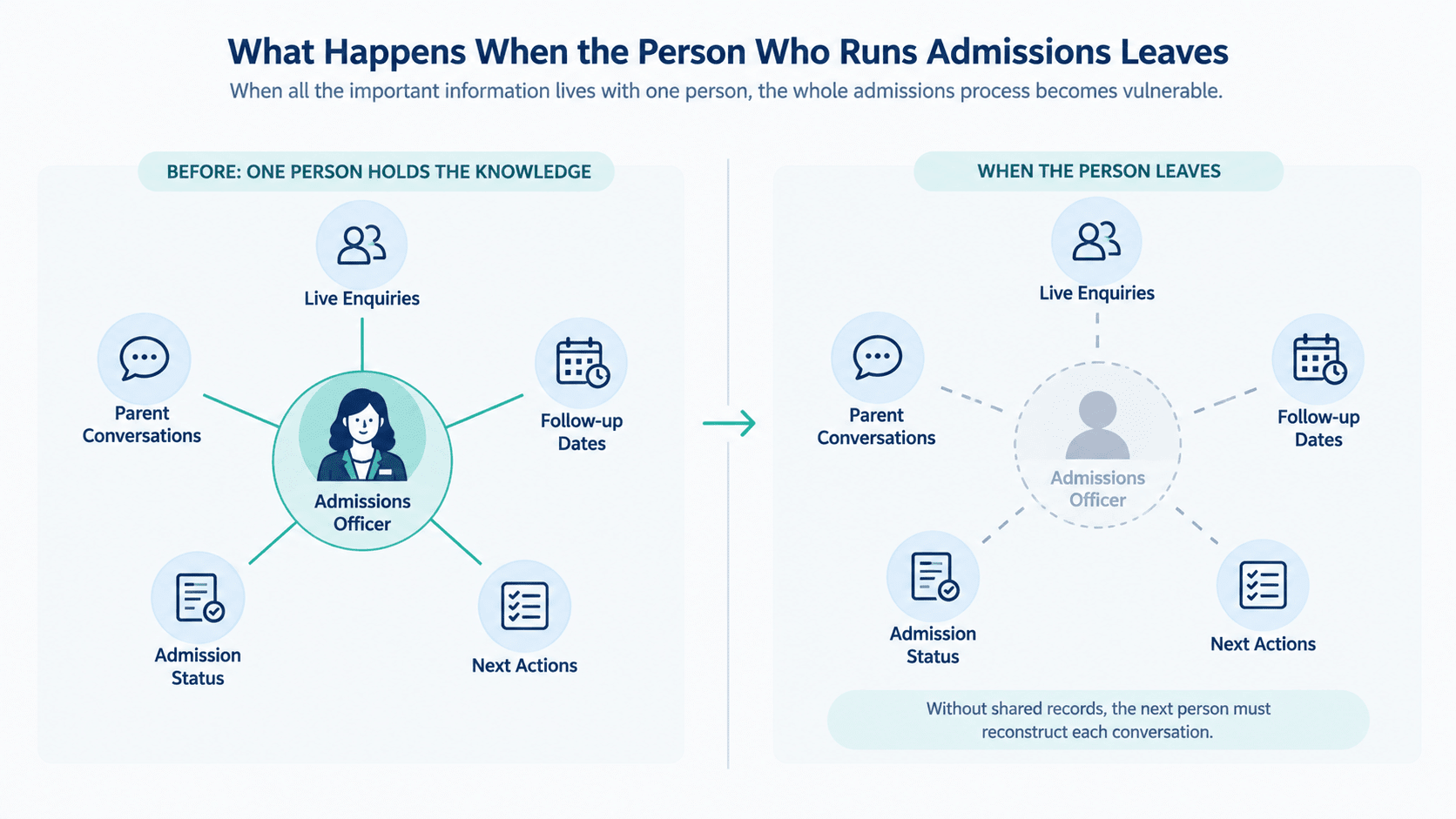
When that person leaves, or takes extended leave, the school does not lose a set of tasks. It loses the context around them.
A replacement can be shown where the enquiry register is kept. What cannot be handed over is the state of forty live conversations. Which parent was close to deciding. Who had an objection that was being worked through. Who had already been called three times and should not be called again this week.
So the new person starts effectively from zero on every open enquiry. They call families who have already been spoken to, sometimes repeating questions that were answered a fortnight ago. Parents notice, and it does not reflect well.
Schools routinely lose a month to this. Not because the work is complex, but because the handover was impossible.
It is not a loyalty problem
The instinct is to treat this as a staffing risk and to manage it by keeping the person happy. That is worth doing for its own sake, but it does not solve the problem.
People leave for reasons that have nothing to do with the school. They move cities, they change careers, they take maternity leave, they fall ill. A school of any size will face this several times a decade.
The exposure is not that a particular individual might go. It is that the school's admission process has no existence independent of whoever is running it. That is a design characteristic, and it can be changed.
The same pattern appears elsewhere
Admissions is the most visible case, but it is rarely the only one.
The accounts officer who knows which concessions were verbally approved and by whom. The senior teacher who knows how the grading weightage has always been applied. The office head who knows which document goes to which board and by when.
In each case the process works well, often better than a written procedure would, precisely because an experienced person is applying judgement. And in each case the school is one resignation away from a difficult few months.
What makes this hard to see is that nothing is going wrong. The work is being done well. The risk is invisible until it arrives.
What a system changes, and what it does not
Putting the admission process into a system does not replace the counsellor's judgement. Knowing how to speak to an anxious parent is not something software does.
What changes is that the state of the process stops being private.
Every enquiry is in one list. Each has a recorded source, an assigned owner, a history of contact and a next action. A person joining tomorrow can open that list and see exactly where every family stands, without needing anyone's recall.
The counsellor's expertise is still theirs. The school's information is now the school's.
The test worth running
There is a simple way to find out how exposed your school is.
Pick the person who handles admissions and imagine they are unavailable for two weeks starting tomorrow. Not gone permanently, just unreachable.
Then ask what the school would be able to do. Could someone else open a list and see every live enquiry with its history? Or would the season effectively pause until they returned?
If the answer is the second, the school does not have an admission process. It has a person doing admissions, and those are different things.
Why this matters more as a school grows
At two hundred students the informal arrangement works, because one person can genuinely hold it all.
At six hundred it strains. At a thousand, across multiple sections and possibly multiple campuses, it stops being possible for anyone to hold the full picture, and the risk shifts from a handover problem to a daily one.
Most schools cross that threshold without noticing, because nothing breaks on a particular day. The system simply becomes less reliable, gradually, until something forces the issue.


Discussions(0)
Join the technical exchange. Professional perspectives and insights welcome.
No thoughts shared yet
Be the first to join the conversation and share your insights on this topic.