

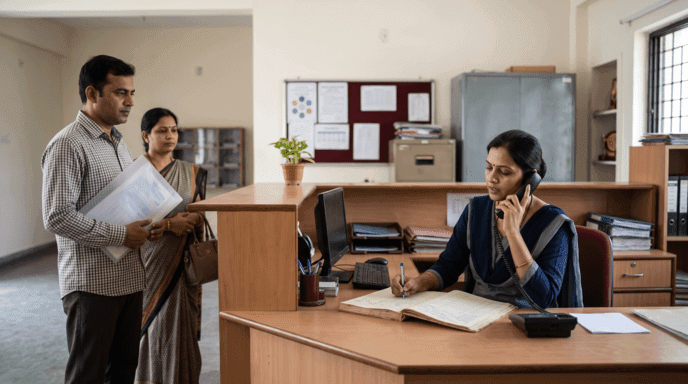
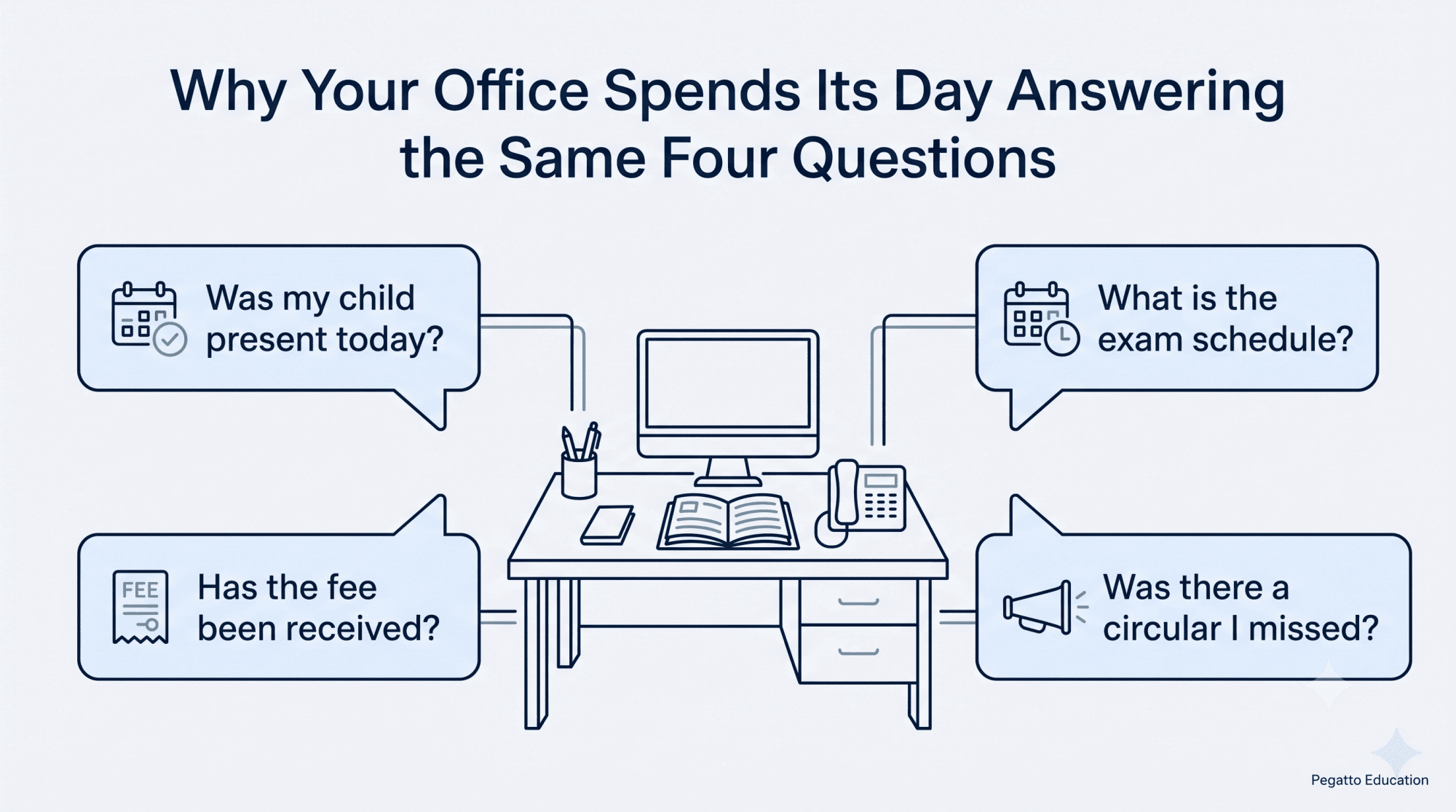
Spend a morning at the front desk of any school and a pattern emerges within the hour. The calls are not varied. They are four questions, asked repeatedly, by different families.
Was my child present today. Has the fee been received. What is the exam schedule. Was there a circular I missed.
Every one of these has an answer the school already holds. What the parent lacks is a way to reach it without a member of staff stopping what they are doing, looking it up, and repeating it.
The volume is not the burden. The interruption is.
A single call takes two minutes. That is not the problem.
The problem is that it arrives while the same person is entering marks, preparing a transfer certificate, or handling a walk-in enquiry. Each call requires them to stop, switch context, open a different register or file, find the answer, and then return to what they were doing.
The work that gets displaced is rarely urgent, which is exactly why it keeps getting displaced. Marks entry slips to the evening. The certificate is promised for tomorrow. The enquiry from a prospective parent is handled more briefly than it deserves.
Multiply that across a few hundred families and it becomes a full-time occupation that appears on nobody's job description and in no budget.
Why parents call rather than check
It is tempting to conclude that parents should be more self-sufficient. That is not what is happening.
Parents call because calling is the only reliable option available to them. The information exists, but it is held inside the school's records, accessible only to staff. There is no version of it the parent can see.
Where schools have tried to solve this with WhatsApp groups, the result is partial. A circular sent to a class group is genuinely useful, but it is a broadcast. It cannot tell an individual parent whether their own child was marked present, or what their own family still owes. For anything specific, the parent is back on the phone.
And there is a second effect worth noticing. A parent who has to call to find out basic information tends to call more often than one who can check, because each call also becomes an opportunity to ask the other three questions.
The comparison parents are actually making
Schools benchmark themselves against other schools. Parents do not.
A parent who receives a payment confirmation from a UPI app in two seconds, who can see a delivery moving on a map, and who gets a message when a bill is due, brings that expectation to the school. Not because they are demanding, but because it is now ordinary everywhere else.
Against that, a receipt issued on Monday for a payment made on Friday feels slow. A fee reminder that arrives after the due date feels careless. Being told to call the office feels like being told the school does not have the information ready.
None of that reflects the quality of teaching, which is what the school is actually being judged on in the long run. But it shapes how organised the school appears, and that impression travels between parents.
What changes when parents can see their own record
The mechanism is simple. Attendance, fees, homework, results and circulars become visible to the parent directly, at whatever hour they think to check.
The immediate effect is fewer calls, and the office gets its day back.
The second effect is less obvious and more valuable. Parents who can see what is happening tend to stay more involved in it. A parent who notices their child's attendance slipping in week three raises it in week three, rather than discovering it at the term meeting when it is too late to act.
The third effect is on the school's own credibility. An institution that shows its work is easier to trust, and trust is what generates referrals. In most schools the largest source of new admissions is existing parents, and their willingness to recommend depends as much on how organised the school feels as on academic results.
The measurement worth taking
If you want to know whether this is a real problem in your school, do not estimate. Count.
For one week, log every incoming call to the office with a single word for what it was about. At the end of the week, count how many were questions the school could already answer.
In most schools the answer is a clear majority. That share is what a parent portal removes, and it is also the fairest estimate of what the current arrangement is costing in staff time.



Discussions(0)
Join the technical exchange. Professional perspectives and insights welcome.
No thoughts shared yet
Be the first to join the conversation and share your insights on this topic.