


Ask a school what manual fee collection costs and the answer usually involves defaulters. That is the visible number, and it is the wrong one to look at.
In most schools the money arrives eventually. Parents who intend to pay do pay. What manual collection costs is time, and a delay between the due date and the recovery that nobody has ever priced.
The list takes longer to prepare than to act on
The cycle in most schools runs like this.
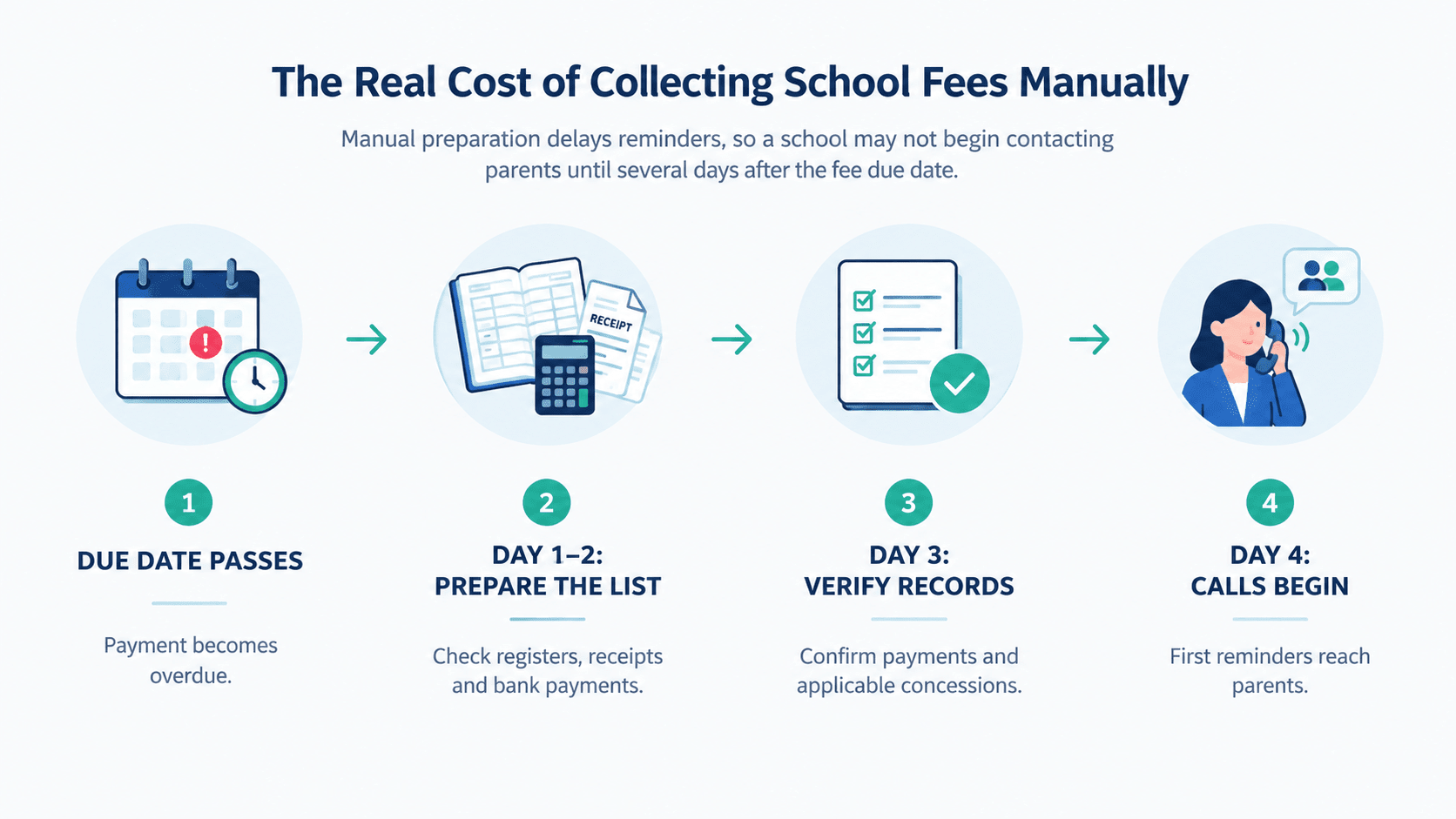
A due date passes. Someone in accounts begins preparing the list of students who have not paid. That means checking the fee register against receipts, cross-referencing payments that came through the bank, and confirming which concessions apply.
For a school of a few hundred students this takes a day. For a larger school it takes two, sometimes three. It is careful work and it cannot be rushed, because a list that names a parent who has already paid damages the school's relationship with that family.
Only when the list is complete does anyone begin calling. Which means the first reminder reaches a parent several days after the payment was due, and the list being used is already a few days out of date.
The reminder arrives after the moment it would have worked
This is the part that costs the most and is discussed the least.
A reminder sent three days before a due date is a helpful note. A parent who had genuinely forgotten pays it that week. A reminder sent five days after the due date is a different conversation entirely. The parent is now behind, may feel embarrassed or defensive, and the exchange becomes awkward for both sides.
Schools that send reminders before the due date recover faster, and they do it without anyone having a difficult conversation. Schools that send them afterwards spend the same effort on a harder task.
The difference is not the reminder. It is the timing, and manual preparation makes the right timing almost impossible.
The position is never current when someone asks for it
A correspondent or trustee asks a reasonable question. What is outstanding right now?
In a manual system the honest answer is that the figure can be prepared, and it will be ready in a day or two. What arrives is accurate as of the day it was compiled.
Every decision made on that figure is therefore made on a number that has already moved. Cash flow planning, salary timing, purchase decisions, all of them rest on a position that is a few days old and that nobody can refresh on demand.
This is not a small problem in a school where fees arrive in instalments across the year.
The hidden labour of reconciliation
Money reaches a school in several ways. Cash at the counter. Cheques. Direct bank transfers. Online payments. In a multi-campus school, collections at each branch.
Each of these lands in a different place and has to be brought together before anyone knows the true position. Somebody matches bank entries against receipts. Somebody confirms that a screenshot on WhatsApp corresponds to a real credit. Somebody consolidates the branch sheets.
This work is invisible on any organisation chart. It is not in anyone's job description. It simply happens, absorbed into the working day of one or two people who have other responsibilities.
It is also the work that grows fastest as the school grows.
What changes when collection is connected
Three things change, and none of them require more effort from the accounts team.
The outstanding position becomes something you open rather than something you prepare. Because payments are recorded as they happen rather than reconciled afterwards, the figure is current whenever anyone asks for it.
Reminders move before the due date. Once the system knows who owes what and when, sending a reminder in advance requires nobody to prepare anything. It simply happens on schedule.
And the difficult conversations reduce, because most parents who would have become defaulters simply pay the reminder they received in time.
The number worth measuring
If you want to know what manual collection is costing your school, do not start with defaulters.
Count the days between the due date and the first reminder reaching a parent. Then count the hours spent each month preparing the list before that reminder could be sent.
Those two numbers are the actual cost, and they are the two that connected fee management changes immediately.



Discussions(0)
Join the technical exchange. Professional perspectives and insights welcome.
No thoughts shared yet
Be the first to join the conversation and share your insights on this topic.