
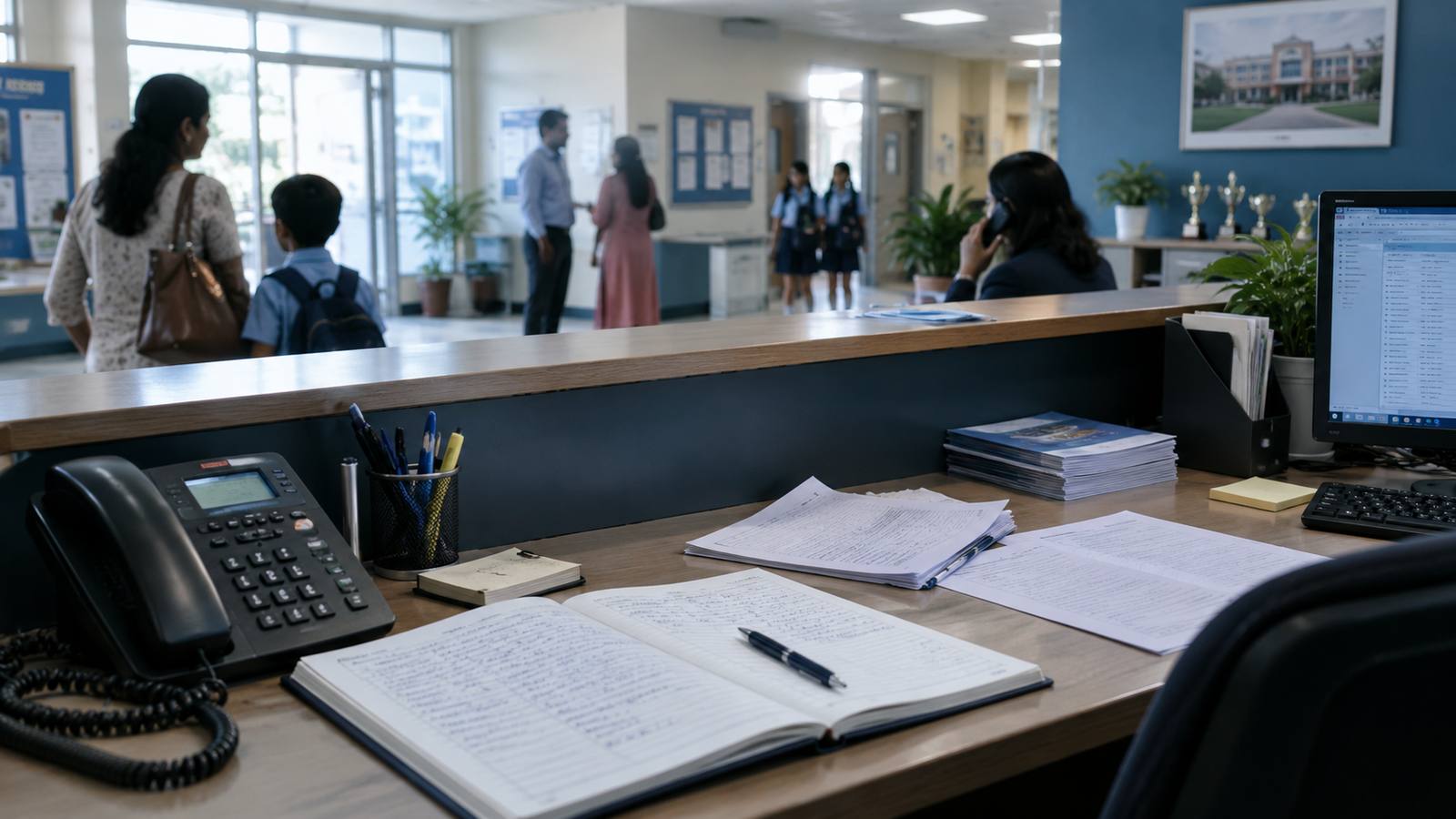
A parent calls at six in the evening. The office has closed. The call goes to the security desk, who writes the name on a slip of paper and leaves it on a colleague's table. That colleague is on leave the next day.
Nobody did anything wrong. The enquiry is simply gone.
This is the most expensive thing that happens in a school every admission season, and it is also the hardest to see. A lost enquiry does not appear in any report. There is no record of the parent who called, no note of the conversation that never happened, and no line item for the seat that stayed empty. The loss is invisible by construction.
Enquiries arrive in more places than anyone is tracking
Ask a principal where admission enquiries come from and the answer is usually confident. Phone calls, walk-ins, the website. Ask the same question of the people who actually receive them and the list gets longer.
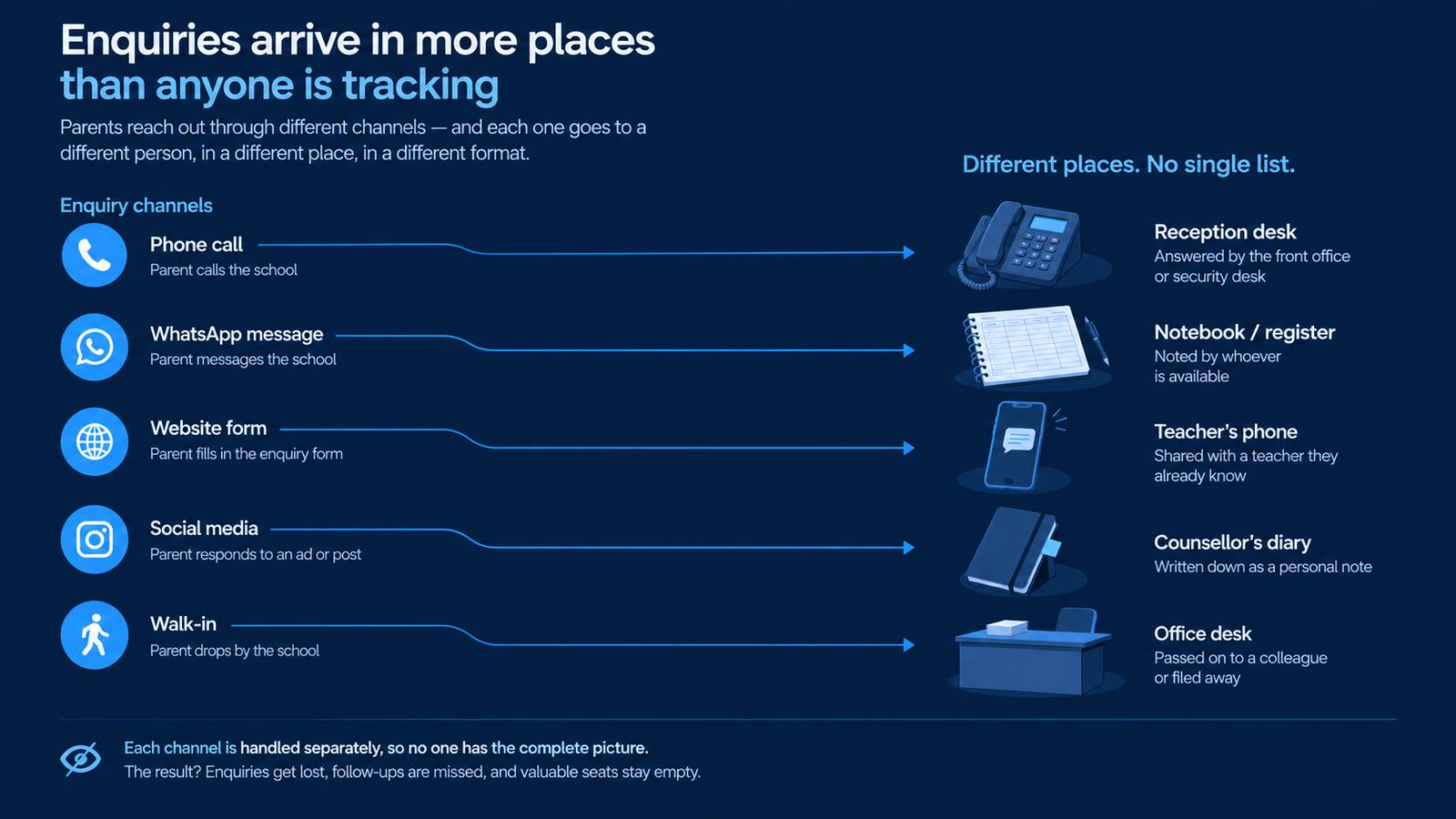
A parent messages the school's WhatsApp number at nine in the evening. Another sends a message to a teacher they already know, because their older child studies there. A third is referred by a current parent and simply arrives at the gate. A fourth fills in a form on a social media advertisement. A fifth calls the number printed on a hoarding, which rings at the accounts desk.
Each of these is received by a different person, in a different place, in a different format. Some are written into a register. Some are noted in a personal diary. Some are answered on the spot and never recorded at all, because the person who handled it assumed someone else would.
The result is that no single person holds the complete list. Not the counsellor, not the office head, not the principal. The list exists only as fragments distributed across several people, and it is never assembled until somebody asks for a total at the end of the season.
Follow-up depends on somebody remembering
The second leak is larger than the first.
An enquiry that is properly recorded still needs someone to act on it. In most schools that responsibility sits with a counsellor who is simultaneously handling walk-ins, taking calls, conducting school tours and answering questions from parents who have already admitted their children.
During the busiest weeks of the season, that person is making judgement calls about who to call back first, based on what they can remember. Not on data, not on any system, but on recall. Under pressure, the enquiries that get followed up are the ones that were most recent or most memorable. The rest wait.
An admission season is short. A parent who was genuinely interested in week two, and who heard nothing, has usually confirmed a seat elsewhere by week six. By then the enquiry is not cold. It is closed, and the school never knew it was slipping.
The loss does not show up in any report
Here is what makes this problem persistent rather than solvable.
Schools count admissions. Almost none count enquiries that arrived and received no response, because you cannot report on something that was never recorded. The number does not appear in the year-end review. It does not come up in a management meeting. There is no column for it anywhere.
So the conversation at the end of a weak season tends to be about marketing spend, or the competition, or fee levels. Those may all be real factors. But the possibility that the school simply did not respond to a share of the parents who approached it is rarely raised, because nobody has the evidence to raise it.
A school can run the same process for a decade without ever discovering how much it costs.
What actually fixes it
Not more effort. The people handling enquiries are usually working hard already, and asking them to remember better is not a plan.
What changes the outcome is that every enquiry lands in one place regardless of which channel it arrived through, and that responsibility for each one is assigned at the moment it is captured rather than assumed afterwards.
Once that exists, three things become possible that were not possible before. Anyone can see the full list. Follow-up reminders can be raised by the system rather than by memory. And at the end of the season the school can see not just how many admissions it made, but how many enquiries it received and where they stopped moving.
That last figure is the one most schools have never seen. It is usually the most useful number in the entire admission process.
The question worth asking
Before the next season begins, ask one question of the team that handles admissions.
If a parent enquired three weeks ago and nobody has contacted them since, how would we know?
In most schools the honest answer is that they would not. That is the problem, and it is a records problem rather than an effort problem.